
Chrisor Luo
Fokis Senior Product Manager for Insulation Systems
9+ years of R&D and on-site troubleshooting experience in HVAC adhesive systems.
Published: 06/05/2026 | Last updated: June 2026
Executive Summary
When aluminum foil peels off NBR insulation, the problem is rarely just “weak glue.” In recurring HVAC insulation failures, the real causes usually come from plasticizer migration, trapped solvents, low surface energy on the foil, or thermal stress during service.
In many cases, standard SBS contact adhesives are not the best long-term solution for NBR-to-foil bonding. Modified acrylic adhesives or factory pre-laminated NBR insulation panels are usually more reliable when plasticizer migration, vapor-barrier bonding and heat exposure are involved.
Why Foil Delamination Matters in HVAC Insulation
In industrial HVAC projects, the aluminum foil layer on NBR insulation is more than a decorative finish. It helps protect the system as a vapor barrier and improves the appearance of ducts, pipes and equipment. Once foil curling, blistering or large-area delamination appears, the project can quickly move from a small quality issue to an expensive rework problem.
• Condensation risk: A damaged foil layer may allow moisture movement and create condensation problems around ducts or pipes.
• High-altitude rework: Repairing insulation after installation can cost several times more than doing the bonding correctly from the beginning.
• Reputation damage: Contractors, distributors and developers may lose confidence when the same peeling problem returns weeks after installation.
For this reason, aluminum foil peeling off NBR insulation should be treated as a system failure, not just a glue strength problem.
3 Common Failure Modes of NBR Insulation Bonding
Before choosing another adhesive, identify where the failure occurs. Field diagnosis usually falls into one of the following three patterns.
| Failure Type | What You See | Likely Cause | Risk Level |
|---|---|---|---|
| A-Interface Failure | The foil peels off cleanly while most adhesive remains on the black NBR surface. | Low surface energy on foil, residual rolling oil, or insufficient wetting. | High |
| B-Interface Failure | The whole NBR-foil laminate detaches from the duct, pipe or substrate. | Poor substrate preparation, dust, oil, weak adhesive or insufficient pressure. | Very High |
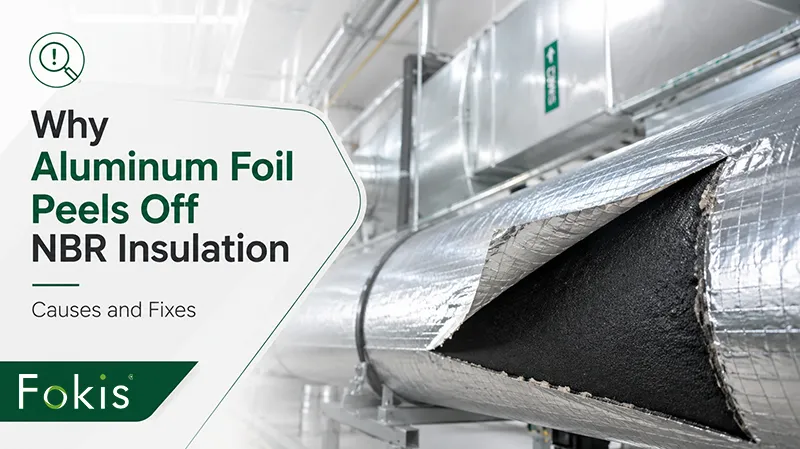
| Cohesive Failure | Adhesive remains on both sides but becomes soft, sticky or “black mush.” | Plasticizer migration from NBR rubber or chemical attack on the adhesive layer. | Critical |
4 Main Causes of Aluminum Foil Peeling Off NBR Insulation
Plasticizer Migration from NBR Rubber
NBR insulation stays flexible because rubber compounds often contain plasticizers. These oily components can slowly migrate toward the adhesive layer. Standard solvent-based contact glues, including some SBS or neoprene systems, may soften when exposed to this migration over time.
Based on our internal comparative aging tests, standard adhesives can lose about 70% of bond strength after exposure to NBR plasticizers at an ambient temperature of 25°C within 30 days. This is why a sample may look strong immediately after bonding but fail after heat, storage or several weeks of service.
Trapped Solvents Under the Foil Layer
Aluminum foil is a vapor barrier. If the adhesive is laminated before it becomes properly touch-dry, solvent can remain trapped between the foil and NBR. When the HVAC system heats up, the trapped solvent expands and creates bubbles, blisters or local peeling.
This is one reason why applying more glue does not always help. A heavier wet coating may actually trap more solvent and increase blistering risk.
Low Surface Energy on Aluminum Foil
Industrial aluminum foil may contain rolling oil or surface contamination. If the adhesive cannot wet the foil surface, the real contact area is much smaller than it looks. The glue may appear to cover the foil, but the bond strength remains unstable.
In factory lamination, corona treatment and controlled surface cleaning are often used to improve wetting. On site, contractors should at least check foil cleanliness and avoid bonding directly onto oily or dusty surfaces.
Thermal Stress and Material Movement
NBR rubber and aluminum foil move differently when temperature changes. If the NBR sheet is stretched during installation, it also has stress memory and will try to recover. A brittle or chemically weakened adhesive layer cannot absorb this movement, so edge curling and peeling appear later.
Why Stronger Contact Glue Does Not Always Solve the Problem
Many contractors respond to foil peeling by asking for a “stronger glue.” In real troubleshooting, this is often the wrong starting point. If the failure comes from plasticizer migration, trapped solvent, poor wetting or stress memory, higher initial tack alone will not solve the long-term failure.
For NBR-to-aluminum foil bonding, the adhesive must have not only initial bonding strength, but also plasticizer resistance, wetting ability, heat resistance, and enough flexibility to handle thermal movement.
Professional Solutions for NBR-to-Aluminum Foil Bonding
| Solution | Why It Helps | Best Use Case | Important Note |
|---|---|---|---|
| Modified acrylic adhesive | Improves resistance to plasticizer migration and maintains a more stable adhesive film over time. | Projects with recurring foil delamination, heat exposure or softened adhesive residue. | Still requires correct open time, coating weight and pressure during bonding. |
| Factory pre-laminated NBR insulation panel | Controls surface treatment, drying, coating weight and pressure in a stable production process. | Large HVAC projects, high-quality insulation systems and applications where rework risk is expensive. | Factory-laminated panels can reach 3-5x peel strength compared with manual site application, depending on material, adhesive and test conditions. |
| Site application SOP | Reduces process errors such as wet bonding, over-application, uneven pressure and contaminated surfaces. | Contractors who must bond or repair foil on site. | A good adhesive can still fail if the site process is uncontrolled. |
Factory pre-lamination is especially useful when quality consistency is critical. Corona treatment can improve surface energy, infrared or controlled drying can reduce trapped solvents, and constant pressure can create a more uniform bond line. In our experience, this controlled process is why pre-laminated panels can achieve 3-5x peel strength compared with manual site application under comparable test conditions.
Common Mistakes That Make Foil Peeling Worse
In troubleshooting, many failures become worse because the first repair attempt only treats the symptom. The table below shows common mistakes and why they fail.
| Common Mistake | Why It Fails | Better Practice |
|---|---|---|
| Applying more glue | A thicker wet layer may trap more solvent under the aluminum foil and increase blistering risk. | Control coating weight and wait until the adhesive is properly touch-dry. |
| Bonding too early | Solvent cannot escape through the foil layer after lamination. | Check tack-up time under actual temperature and ventilation conditions. |
| Using stronger contact cement only | Initial strength does not solve plasticizer migration or poor foil wetting. | Select an adhesive system with plasticizer resistance and good surface wetting. |
| Ignoring foil surface oil | Rolling oil or dust reduces real contact area between adhesive and foil. | Clean or treat the surface when needed and test wetting before production. |
| Stretching NBR during installation | The rubber tries to recover later, pulling the foil layer and causing edge curling. | Install without unnecessary stretching and press evenly after bonding. |
Basic Site Check Before Bonding Aluminum Foil to NBR
A full SOP should be adjusted according to material grade, adhesive type, local climate and project requirements. The following checklist is a practical starting point for site teams.
| Step | What to Check | Why It Matters |
|---|---|---|
| 1. Check foil surface | Look for oil, dust, fingerprints or release residue. | Poor surface wetting is a common reason for clean peeling. |
| 2. Check NBR condition | Avoid stretched, wet or contaminated insulation surfaces. | Stress memory and contamination reduce long-term bonding reliability. |
| 3. Apply evenly | Avoid heavy wet spots and uncoated areas. | Uneven coating leads to trapped solvent, weak points or hard spots. |
| 4. Wait for touch-dry condition | Do not laminate while the adhesive is still wet or stringy. | Trapped solvent under foil can cause blistering after heating. |
| 5. Press uniformly | Press from the center outward and apply enough pressure. | Good pressure improves contact and helps remove trapped air. |
| 6. Verify after curing | Check peel strength after 24 hours and after heat exposure if possible. | Some failures appear only after aging, heat or packaging. |
Fokis support
Frequently asked questions
Why does aluminum foil peel off NBR insulation?
The most common reasons are plasticizer migration from NBR rubber, trapped solvents under the foil, low surface energy on the aluminum surface, and thermal stress during service.
Why does the adhesive turn into black mush?
This usually indicates chemical softening or plasticizer migration. The adhesive film is being attacked from inside the bond line, so simply choosing a stronger contact glue may not solve the problem.
Can stronger contact glue fix foil delamination?
Not always. If the failure is caused by oil migration, trapped solvent or poor wetting, higher initial tack alone will not prevent long-term peeling.
Why does peeling often happen in summer or after heating?
Heat accelerates plasticizer migration, solvent expansion and thermal movement between aluminum foil and NBR rubber. Summer or operating heat can expose weak bonding systems.
What adhesive is better for bonding aluminum foil to NBR?
For recurring delamination, modified acrylic adhesives are usually more reliable than standard contact adhesives because they can provide better plasticizer resistance and long-term stability.
How can contractors prevent NBR insulation peeling on site?
How can contractors prevent NBR insulation peeling on site?
Get Technical Support
If your project has repeated aluminum foil peeling, do not rely only on visual inspection or stronger glue. Send us your NBR sample, aluminum foil type, current adhesive, application method and failure photos. Our technical team can help analyze the failure mode and recommend a suitable adhesive direction or bonding test method.
• Download the SOP: The Standard Guide to NBR Insulation Bonding
• Free lab testing: Peel strength and aging comparison for your NBR and foil samples
• Sample request: Try modified Fokis® acrylic adhesive on your actual material system