
Published: Sep. 2026 | Updated: Sep. 2026
Planning to send samples from Africa to China for adhesive testing? This guide explains how to prepare foam, nonwoven fabric and adhesive samples for FOKIS in Foshan, China, contact a local courier and confirm the shipping documents before dispatch.
If you manufacture mattresses, furniture, upholstery, footwear, insulation or packaging, testing an adhesive on your own production materials helps assess whether it suits your application. Foam density, fabric coatings, surface treatments and production conditions can all affect the final bond. FOKIS can discuss adhesive selection and, where appropriate, custom formulation development based on your materials and requirements.
Below you will find the FOKIS sample receiving address, official DHL, FedEx and UPS contacts in selected African countries, packing guidance, chemical-shipping checks and the steps toward a production-line trial.
Shipping guidance and official contact links reviewed: 18 September 2026. Confirm shipment-specific requirements before booking.
How FOKIS Turns Your Samples into an Adhesive Solution
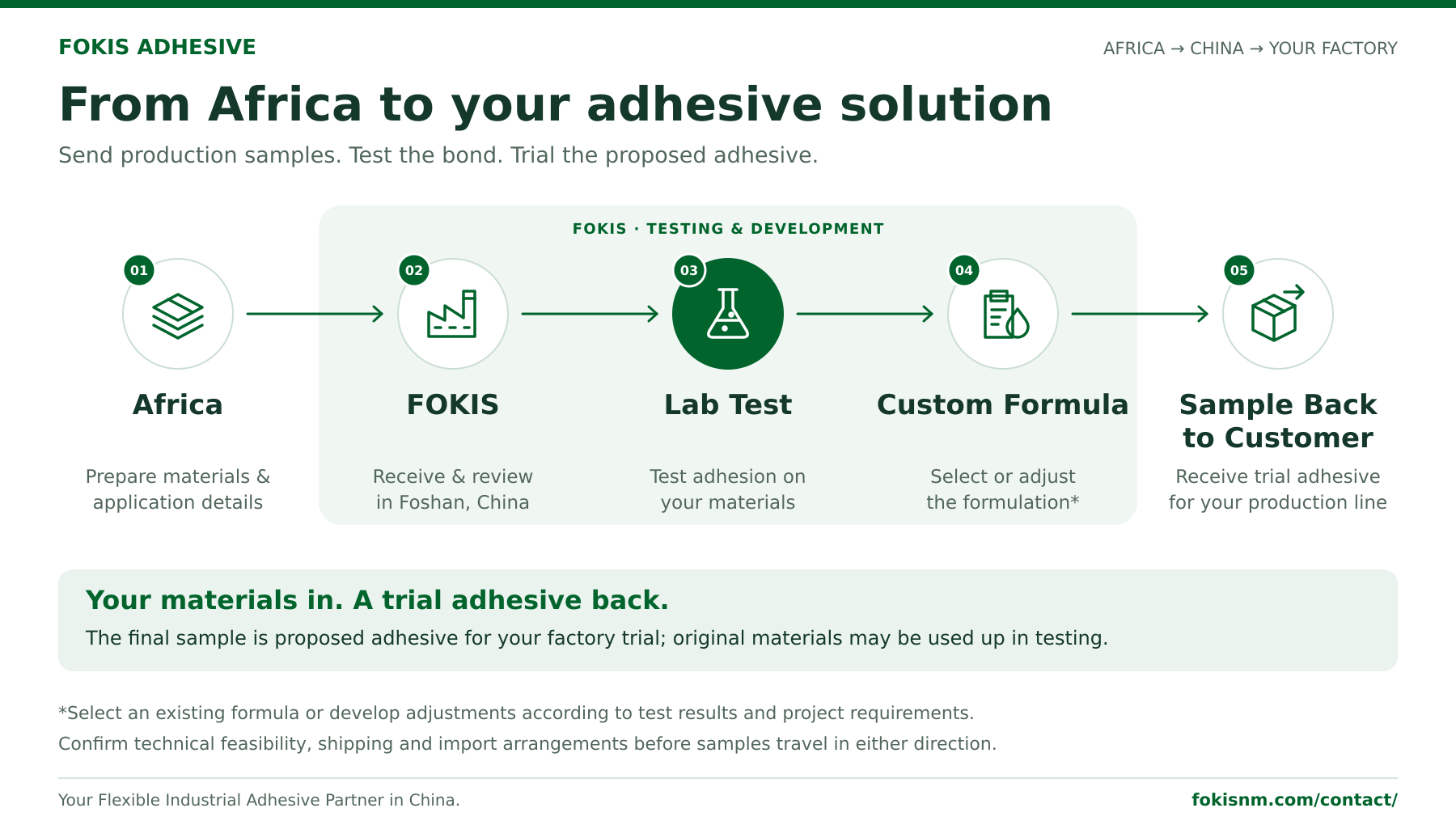
Africa → FOKIS → Lab Test → Custom Formula → Sample Back to Customer. The outgoing sample is trial adhesive for the customer’s production line.
- Africa — prepare your samples. Share your bonding requirements and agree on the production materials or adhesive samples to send.
- FOKIS — receive and review. The receiving point in Foshan, China accepts the agreed shipment, and FOKIS confirms the evaluation scope.
- Lab Test — evaluate the bond. Candidate adhesives are assessed on your actual materials under the agreed test plan.
- Custom Formula — select or adjust. FOKIS may select an existing formulation or assess adjustments based on the results and project requirements.
- Sample Back to Customer — trial the adhesive. Once a suitable candidate and shipping arrangements are agreed, a trial adhesive sample can be sent for evaluation on your production line. Your feedback informs the next steps.
Original material samples may be consumed or altered during testing. Confirm technical feasibility, transport acceptance, import requirements and costs before shipping in either direction.
Start here
Sending foam, nonwoven fabric or other clean, dry manufactured materials? Contact FOKIS to agree on the samples, then ask a local courier about shipment to mainland China.
Sending an adhesive, hardener, primer or another chemical? Send the product's current Safety Data Sheet (SDS) first. Arrange shipping only after the transport requirements and the China-side import arrangements have been checked.
You do not always need to send your current adhesive. For many projects, both materials to be bonded, application details and photos are a useful starting point.
FOKIS Sample Receiving Address in China
FOKIS SAMPLE RECEIVING POINT — 科奇样品接收处
Contact: Liang Xiaoma / 梁小马
Telephone: +86 13413239469
Delivery address in English:
No. 24, Hebei 6th Road South, Xingtan Town, Shunde District, Foshan, Guangdong, China
Chinese delivery label — include this on the parcel:
广东省佛山市顺德区杏坛镇河北六路南24号(科奇样品接收处)
梁小马 +86 13413239469
Before dispatch: Contact FOKIS to confirm the sample contents and receiving arrangements. Ask for the postal code if required by your courier, and obtain the registered consignee/importer details needed for customs paperwork.
The receiving-point name above identifies the delivery location. It should not automatically be used as the registered company name on a customs declaration. Use the company and importer information confirmed by FOKIS and the clearance provider.
For technical enquiries and document submission, use the FOKIS contact page or your existing FOKIS representative. China uses UTC+8; allow for the time difference when calling.
1. Choose Material Samples for Adhesive Testing
Send both sides of the bond. If you need to bond foam to nonwoven fabric, send the foam and the nonwoven. For aluminium foil laminated to NBR insulation, send both materials, including any coating or facing used in production.
| Sample | Suggested preparation for discussion with FOKIS |
|---|---|
| PU foam or sponge | Several pieces around 300 × 300 mm; retain the production thickness and provide the density if known. |
| Nonwoven fabric or textile | Several representative sheets; identify composition, weight in g/m² and any coating or treatment. |
| Synthetic leather, rubber or plastic sheet | Pieces with the actual production surface; identify the material and the bonding side. |
| Aluminium foil or insulation facing | Include each layer involved in the bonding process and identify coated sides. |
| Wood, board or natural leather | Send photos and material/processing details first so shipping and import requirements can be checked. |
| Failed bonded assembly | Discuss sending 1–3 representative pieces, ideally with unused material from the same batch. |
| Current adhesive, primer or hardener | Send the SDS and proposed quantity first. Each chemical component needs its own review. |
The quantities and dimensions are starting suggestions. Confirm the test plan and sample quantity with FOKIS before cutting or shipping.
The dimensions above are starting suggestions, not a fixed testing requirement. FOKIS should confirm the quantity before you cut or ship anything. Repeated trials, ageing tests and formulation comparisons may require more material. Keep matching samples at your factory for comparison.
Avoid washing, sanding or otherwise changing the bonding surface unless that is part of your normal production process. Tell us about surface contamination or residual adhesive; do not conceal it or clean away the evidence of a failure without discussing it first.
Shipping foam samples to China
Label each foam grade with its material type, production thickness and density if known. Include the material it will be bonded to. If you are investigating a failed bond, discuss sending both an affected assembly and unused foam from the same batch. Confirm the packed dimensions with your courier before booking.
Shipping nonwoven fabric samples to China
Identify the fibre composition, weight in g/m², coating or treatment, and the side used for bonding. Send the actual production grade together with the matching foam, film or other substrate. Keep different fabric grades separately labelled so FOKIS can match each test result to the correct material.
Which materials need an extra check?
Do not assume that every item described as a “non-chemical sample” is unrestricted. Tell the courier and FOKIS if the package contains untreated wood, raw hides, other animal or plant material, soil, biological contamination, uncured adhesive or solvent residue. Ask whether the material can be imported and whether inspection, quarantine or other documents are needed.
For chemical products, neither “water-based” nor “solid hot melt” is, by itself, a transport classification. Classification depends on the actual product and the relevant mode of transport.
2. Explain the Bonding Problem Before Shipping
Send photos or a short production video together with the following information:
- Your company, country, city and contact details.
- The two materials being bonded, including their specifications and surface treatments.
- Application method: spray, roller, brush, extrusion or another process.
- Current adhesive type and product name, if available.
- Working temperature and humidity, line speed, coating amount and pressing conditions, where known.
- Required open time, initial tack, final strength, flexibility or heat resistance.
- The failure you need to solve and when it occurs.
- Any product or market requirements that the adhesive must meet.
For example:
Application: Mattress manufacturing
Materials: PU foam and polypropylene nonwoven fabric
Method: Spray application
Problem: The bond separates after compression packaging
Target: Better initial tack and bond retention after compression
Supporting information: Foam density, fabric weight, time before compression and photos of the separated surfaces
Use your actual factory and storage conditions. Requirements can vary substantially between locations, seasons and production lines; there is no single set of conditions that represents all African factories.
3. DHL, FedEx and UPS Contacts in Africa
For small quantities of suitable manufactured material samples, an international express courier is a practical option to investigate first. Ask for delivery to Foshan, Guangdong, mainland China, including the final delivery to the receiving address above.
The links below lead to official country customer-service pages. They are enquiry routes, not confirmation that a carrier accepts your particular sample or dangerous-goods shipment.
Swipe horizontally to view all courier contacts.
| Country of dispatch | DHL customer service | FedEx customer support | UPS contact information |
|---|---|---|---|
| South Africa | DHL South Africa | FedEx South Africa | UPS South Africa |
| Nigeria | DHL Nigeria | FedEx Nigeria | UPS Nigeria |
| Kenya | DHL Kenya | FedEx Kenya | UPS Kenya |
| Ghana | DHL Ghana | FedEx Ghana | UPS Ghana |
| Tanzania | DHL Tanzania | FedEx Tanzania | UPS Tanzania |
| Uganda | DHL Uganda | FedEx Uganda | UPS Uganda |
| Egypt | DHL Egypt | FedEx Egypt | UPS Egypt |
| Morocco | DHL Morocco | FedEx Morocco | UPS Morocco |
Official enquiry pages only. Shipment acceptance depends on the goods, route and service; confirm chemical transport and China-side import arrangements before booking.
How to use these pages: On DHL, select the contact option for customers without a tracking number, then choose DHL Express for a parcel enquiry. On FedEx or UPS, use the displayed contact form, telephone number or local service contractor. If a site changes your country automatically, select your country of dispatch again. Customers elsewhere in Africa can use the carriers' country selectors to find their local support.
Some countries are served through nominated or authorised local contractors. For example, the FedEx Tanzania page and UPS Uganda page identify their local operators and contact details. Check the official page for current information before booking.
Questions to ask your local courier
- Can you collect from my city and deliver these exact goods to the stated address in mainland China?
- Do you accept this commodity on the proposed route? For chemicals, who reviews the SDS and confirms acceptance?
- What export paperwork, shipper registration or account arrangements are needed locally?
- What documents and importer details will the China clearance team require?
- What packaging, quantity limits and service restrictions apply?
- What does the quote include, and who will pay freight, clearance charges and any import duties or taxes?
Provide the packed dimensions and gross weight when requesting a quote. Lightweight foam can occupy a large box, so ask about dimensional weight, not just scale weight. FedEx explains dimensional weight here.
Request an estimate for your actual origin and contents. Avoid planning around a fixed “Africa to China” price or delivery time; collection location, service, customs processing and shipment type all matter.
Copy-and-send courier enquiry
Hello, we would like to send laboratory samples from [city, country] to Foshan, Guangdong, mainland China.
Contents: [specific material/product names, composition and quantities].
Packed dimensions: [L × W × H, cm]. Gross weight: [kg].
Purpose: industrial adhesive bonding evaluation; not for resale.
[For chemicals: please review the attached current SDS and confirm the applicable transport requirements.]
Please confirm shipment acceptance, collection options, required documents, packaging requirements, the estimated transit time and all applicable charges, including China-side clearance arrangements.
4. Adhesive Sample Shipping to China: SDS and Transport Checks
Discuss chemical samples before dispatch, even if the quantity is small. Include primers, hardeners and cleaning agents in the review; do not add an undeclared bottle to a box of fabric samples.
Start with the current SDS
Send the manufacturer's SDS matching the exact product, plus the product name, photographs of its label, proposed quantity and container size. Section 14 is a starting point for transport information; relevant details can include the UN number, proper shipping name, hazard class and packing group.
Check that the information covers air transport if the shipment will travel by air. An incomplete SDS, a blank transport section or a sea-only statement does not establish air-transport status. IATA advises obtaining further information from the manufacturer/distributor or an authorised laboratory when the SDS does not establish a reliable classification. IATA dangerous-goods classification guidance
If the product is not regulated as dangerous goods for the proposed transport
Ask the carrier to confirm acceptance of the specific chemical, packaging, quantity and route. A non-DG classification does not itself guarantee courier acceptance or import clearance. Additional product information or a transport assessment may be requested.
Use an accurate description, for example, only where it matches the contents:
Industrial water-based adhesive, product [name/model], [quantity], for laboratory bonding evaluation; not for resale. SDS provided.
If the product is dangerous goods
Use a carrier-approved DG service or a freight forwarder able to handle the exact shipment from your country to China. Have appropriately trained personnel prepare it under the applicable regulations and carrier requirements. Packaging, quantity limits, marks, labels and transport documents must suit the classification; a Shipper's Declaration may be required. FedEx South Africa: preparing dangerous-goods shipments
Acceptance varies by commodity, quantity and country. Confirm the route with the carrier's DG team before booking. FedEx South Africa: dangerous-goods acceptance
Do not assume that a small bottle, a “sample” label or limited quantities remove the requirements. Do not assign a UN number from a generic example, change the goods description to conceal the chemical, or prepare DG packaging using ordinary-parcel instructions.
If a compliant route is unavailable or too costly, ask FOKIS whether the project can begin with your substrates, technical data and application information instead.
Confirm China-side import arrangements separately
Transport classification and China's hazardous-chemical import requirements are separate checks. FOKIS and the clearance provider need to confirm the importer, product eligibility and required documents before the shipment leaves your country.
For products covered by China's hazardous-chemical import rules, additional declarations, inspection arrangements, Chinese safety labels and Chinese SDS documentation may apply. China's General Administration of Customs sets out relevant requirements in Announcement No. 129 of 2020, reproduced by the Ministry of Commerce, with further inspection provisions in Announcement No. 29 of 2023. Have the clearance provider confirm the current requirements for your product.
5. Customs Documents for Sending Samples to China
Material and adhesive samples are goods, even when they are supplied free of charge. Use the invoice format required by your carrier; a commercial invoice is commonly required, and a pro forma invoice should be used only if accepted for the shipment.
Declare a realistic customs value. Do not automatically enter USD 0 or a token value simply because the goods are samples. FedEx's sample-shipping guidance requires an accurate value and suggests considering replacement cost when assessing it. This is general valuation guidance, not a promise of duty exemption in China. FedEx: sample invoices and values.
Prepare the following information for your courier or broker:
| Information | What to provide |
|---|---|
| Shipper | Company/name, full address, telephone, email and any locally required registration details. |
| Consignee and importer | The registered information confirmed by FOKIS; identify a separate importer if applicable. |
| Delivery contact | Liang Xiaoma / 梁小马, +86 13413239469, and the receiving address above. |
| Goods description | Exact material or chemical name, composition, form and intended use. |
| Quantity and weight | Units, net/gross weight and package count as requested. |
| Value and currency | Defensible unit values and total customs value. |
| Country of origin | The actual country of manufacture, which may differ from the dispatch country. |
| HS classification | Confirm with the courier/broker for each material; do not use one code for all samples. |
| Reason for export | Samples for industrial adhesive laboratory testing; not for resale. |
| Supporting documents | Packing list, SDS and any other documents required for the contents and route. |
| Payment arrangements | Agreed responsibility for freight, clearance, duties/taxes and other charges. |
Use the registered consignee/importer details confirmed by FOKIS. The sample receiving-point name is a delivery reference and should not automatically be used as the customs company name.
List different materials separately. Instead of writing only “samples,” use descriptions such as:
- Polypropylene nonwoven fabric sheets for industrial adhesive bonding tests; not for resale.
- Polyurethane foam pieces for industrial adhesive compatibility tests; not for resale.
FedEx's Nigeria commercial-invoice guide and downloadable form can help you prepare the paperwork. It recommends describing what the goods are made of and what they are used for.
“Not for resale” explains the intended use; it does not guarantee tax exemption or waive import restrictions. Confirm any applicable sample relief and charges with the China clearance provider. Keep the invoice, waybill, packing list and actual contents consistent, and send draft paperwork to FOKIS before dispatch.
6. Pack and Label Material and Adhesive Samples
For clean, dry material samples accepted for ordinary carriage:
- Protect each material separately from moisture, dirt and abrasion; use a sturdy outer carton.
- Mark each sample with a project reference and material identity, such as A — PU foam, density 28 kg/m³ or B — PP nonwoven.
- Identify the bonding side without putting tape or ink on the test area.
- Protect failed bond interfaces so they remain useful for inspection.
- Avoid permanently compressing foam or creasing coated surfaces merely to reduce parcel size.
- Include a printed sample list, application summary, company name and contact details inside the parcel.
- Put the receiving contact and Chinese address on the outer parcel, alongside the carrier's shipping label, without covering barcodes.
Use a suitable carton where practical. If wood packaging is necessary, ask the courier about applicable treatment and marking requirements. ISPM 15 concerns wood packaging; it is not a substitute for checking the import requirements of a wood sample itself. IPPC: regulation of wood packaging material.
For adhesives and other liquids, obtain product-specific packing instructions from the carrier. Appropriate containers, closures and leak protection are necessary; DG samples require the applicable DG packing procedure. Do not apply the ordinary-material checklist above as a complete chemical-packaging guide.
7. Confirm Costs, Dispatch and Send the Tracking Number
Before booking, agree with FOKIS who will pay the incoming freight, any clearance or inspection charges, import duties/taxes and the later shipment of trial adhesive. Confirm any testing or development charges and expected timing for your project. Do not assume the whole process is free or use receiver billing without agreement.
After collection, send FOKIS:
- The carrier name and tracking/air-waybill number.
- The final invoice and sample list.
- Photos of the labelled contents and packed parcel.
- The estimated arrival date and the courier's contact/reference for any special arrangements.
Keep your shipper contact available until delivery. If tracking shows a clearance query, contact the carrier and notify FOKIS promptly so the requested information can be supplied.
Custom Adhesive Testing in China: From Samples to Factory Trials
Custom adhesive testing in China starts with your materials, bonding requirements and production conditions. Once FOKIS receives the agreed samples, the next steps can include selecting an existing adhesive, comparing candidate formulations and assessing whether further development is appropriate.
- Review the application. FOKIS checks the materials, bonding problem and operating conditions, then agrees on the evaluation scope.
- Select candidate adhesives. An existing water-based, solvent-based or hot melt formulation may already be suitable.
- Run laboratory comparisons. Depending on the agreed test plan, the team can compare initial tack, working time, bond strength and the way the bond fails. Additional heat, ageing or flexibility evaluations should be discussed for the application.
- Adjust the formulation where appropriate. Testing may guide changes to properties such as viscosity, open time, drying speed or flexibility. Development feasibility and performance targets are assessed for the individual project.
- Arrange a factory trial. If a suitable candidate is identified, discuss a trial quantity and shipment to your country. This is a separate export/import movement: carrier acceptance, destination-country requirements, documentation and costs need their own confirmation.
- Validate and finalise. Test the proposed adhesive on your production line and share the results. Formula approval, commercial quantity, price, lead time and packaging can then be agreed.
Laboratory results do not replace validation under your real spray equipment, coating weight, temperature, pressing conditions and production speed. If you require an accredited test report or a particular test standard, discuss that scope before sending samples.
Ready to Send Samples to FOKIS?
Before you send samples from Africa to China, contact FOKIS to confirm your bonding requirements and check that:
- FOKIS has agreed on the materials, quantity and evaluation scope.
- Both sides of the bond and the relevant process details are included.
- Chemical classification, carrier acceptance and China-side import arrangements have been checked where applicable.
- The courier has the correct receiving address and confirmed customs consignee/importer details.
- Descriptions, quantities, values and supporting documents match the contents.
- Packaging, payment responsibilities and the required postal code have been confirmed.
FOKIS SAMPLE RECEIVING POINT / 科奇样品接收处
Liang Xiaoma / 梁小马 — +86 13413239469
广东省佛山市顺德区杏坛镇河北六路南24号(科奇样品接收处)
No. 24, Hebei 6th Road South, Xingtan Town, Shunde District, Foshan, Guangdong, China
Contact FOKIS about your samples and bonding requirements before arranging collection.
FOKIS ADHESIVE
Your Flexible Industrial Adhesive Partner in China.