
Written by Fokis Editorial Team
Published: Oct. 2026 | Updated: Oct. 2026
A product data sheet can help you shortlist an adhesive. The next question is whether it works on the materials coming off your production line.
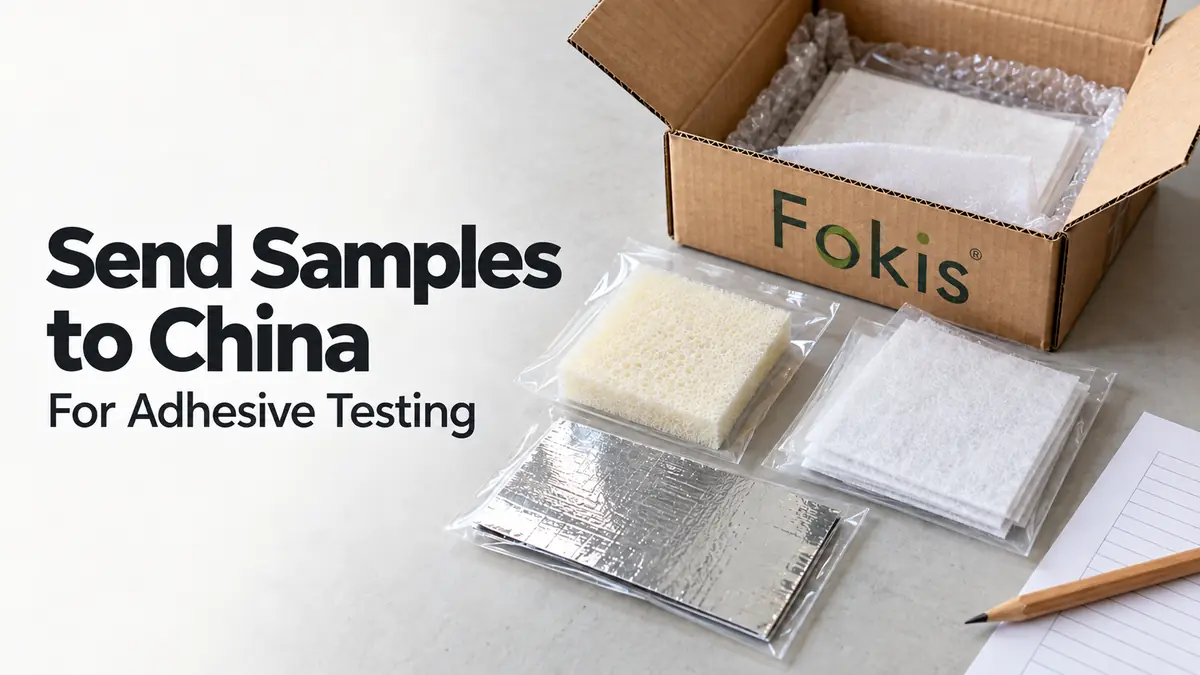
If you are looking for an adhesive for foam, fabric, footwear, insulation or another manufacturing application, you can discuss sending your materials to Fokis in Foshan, China. This guide explains what to prepare, what to check before shipping and how the samples can lead to a factory trial.
Start by sending us photos and a brief description of the bond you need. For many projects, the two materials being bonded are enough to begin an evaluation; your current adhesive may not be needed. If a chemical sample is necessary, its shipping and import requirements need to be checked before dispatch.
*Shipping references checked: 6 October 2026. Confirm the requirements for your actual goods and route before booking.
1. Tell Us What the Bond Needs to Do
Before cutting samples or paying for a courier, contact Fokis with the materials you want to bond and the problem you are trying to solve.
“Foam to fabric” is a useful start. “PU foam to polypropylene nonwoven, spray applied, separating after mattress compression” gives us more to work with.
Include:
- The identity and specifications of both materials, including coatings or surface treatments.
- How you apply the adhesive and assemble the parts.
- When the problem appears: during assembly, after drying, during packing or in use.
- Your production temperature, humidity and process timing, where known.、
- The performance you need, such as faster handling, flexibility or heat resistance.
Photos of the separated surfaces can help. A short production video is also useful when spray technique, assembly timing or pressing may be involved.
If you have a required test method or customer specification, share it at this stage so we can discuss the evaluation scope.
2. Send Both Materials—and Label the Bonding Surfaces
The most useful samples represent what you actually use in production. If the foam is bonded to a coated fabric, send that fabric rather than a similar-looking uncoated grade.
| Your application | Materials to discuss sending |
|---|---|
| Mattress or upholstery bonding | Each relevant foam grade and its matching fabric or nonwoven |
| Insulation lamination | The insulation material and the actual foil, film or facing |
| Footwear assembly | The specific upper, lining or sole materials involved |
| Wood or panel bonding | The board and matching veneer, laminate or other surface, with material details provided first |
| Bond failure investigation | An affected assembly and unused materials from the same batch, where available |
Mark the bonding side and give each material a simple reference, such as A: PU foam and B: PP nonwoven. Add thickness, density or fabric weight where known.
Ask us to confirm dimensions and quantity before cutting. A few small pieces may suit an initial comparison, while repeated trials or ageing tests can need more material. Keep matching samples at your factory.
Avoid changing the surface just to make the sample look cleaner. If washing or sanding is part of your normal process, explain that. If it is not, it could change what we are evaluating.
3. Check Adhesive Samples Before Arranging Shipping
Material samples and chemical samples need different preparation. An adhesive, primer, hardener or cleaning agent should be discussed individually—even if you only intend to send a small bottle.
Send Fokis and the carrier the current Safety Data Sheet (SDS) for the exact product, a label photo, the proposed quantity and the container size.
Section 14 of an SDS is the usual starting point for transport information. However, IATA warns that an SDS may not establish a reliable transport classification. Missing or unclear information should be resolved with the manufacturer, distributor or an authorised laboratory. [1]
“Water-based” does not by itself confirm that a product can travel as an ordinary parcel. Likewise, a small quantity or a sample label does not automatically remove dangerous-goods requirements.
If the product is regulated as dangerous goods, arrange an accepted service and have appropriately trained personnel prepare the shipment under the applicable rules. Ask about the required packaging, labels and transport documents before booking. [2]
Carrier acceptance and China-side import clearance are separate checks. For products subject to China's hazardous-chemical import rules, declarations, inspection arrangements, Chinese safety labels and Chinese SDS documentation may be required. Fokis and the clearance provider should confirm the arrangements for the particular product. [3]
If sending the adhesive is impractical, ask whether the evaluation can begin with your materials, technical data and process information instead.
4. Choose a Carrier and Prepare Clear Customs Documents
For a small shipment of accepted, clean, dry manufactured materials, ask an international courier such as DHL Express, FedEx or UPS about delivery to Foshan, Guangdong, mainland China. Availability and acceptance depend on your origin, the contents and the service.
Provide the packed dimensions as well as the weight. Foam can be light but bulky, and dimensional weight may affect the quote. [4] For bulky samples or chemicals needing specialist handling, discuss a suitable freight forwarder.
Ask what the quote covers, what documents are required and who will handle China-side clearance. Agree with Fokis who pays freight, clearance charges and any duties or taxes before using receiver billing.
If you are shipping from Africa, our Africa sample-shipping guide provides country-specific courier contact links.
Describe the contents, not just their purpose
Free samples still need accurate paperwork and a realistic customs value. FedEx's sample guidance calls for a commercial invoice even for low-value samples; use the invoice format required for your shipment. “No Commercial Value” is not a substitute for declaring a value. [5]
A useful goods description identifies the material, its form and its use. For example, where accurate:
Polypropylene nonwoven fabric sheets for industrial adhesive bonding tests; not for resale.
List foam, fabric and other materials separately. Prepare the shipper and consignee details, quantities, weights, values and currency, country of manufacture, and the HS classifications confirmed with your courier or broker. Add a packing list, SDS and other supporting documents where required.
The country of manufacture may differ from the country you are shipping from. “Not for resale” explains the purpose; it does not automatically make the shipment exempt from tax or import requirements.
Send draft paperwork to Fokis before dispatch so receiving and importer details can be checked.
5. Pack Samples So They Remain Useful for Testing
For dry materials accepted for ordinary carriage, protect each grade separately from dirt, moisture and abrasion. Use a sturdy carton and place the sample references where they will not interfere with the test surfaces.
Avoid crushing foam or creasing a coated facing to fit a smaller box. Protect failed bond surfaces rather than rubbing them clean.
Include a printed sample list and your project details inside the parcel. A simple note can be enough:
Project: Mattress compression-packaging trial
A: PU foam, [density and thickness]
B: PP nonwoven, [weight and surface treatment]
Application: Spray bonding
Problem: Separation after compression
Target: Bond retained after unpacking
Contact: [Name, company, email and telephone]
Tell Fokis and the courier about untreated wood, raw animal or plant materials, contamination or chemical residue so any additional import checks can be assessed.
For adhesives and other liquids, follow the product-specific packing instructions agreed with the carrier. Ordinary material-packing advice is not a complete procedure for chemical or dangerous-goods shipments.
After collection, send us the tracking number, final invoice, sample list and photographs of the labelled contents.
6. What Happens After Fokis Receives Your Samples?
The first task is to match the samples to your application and the agreed evaluation plan.
Depending on the project, Fokis may compare existing water-based, solvent-based or hot melt adhesives on your materials, then assess whether formulation adjustments are appropriate. The aim is to identify a candidate worth trying under your production conditions.
A laboratory bond is one part of that decision. Your spray equipment, coating amount, assembly time and factory conditions still need to be considered in a production trial.
If a suitable candidate is identified, discuss a trial quantity and shipment to your country. That outgoing adhesive shipment needs its own transport and destination-country import checks.
Before starting, agree on the test scope, expected timing and any testing or development charges. If you need an accredited report or a specific standard, raise that requirement first. Also discuss sample returns: tests may cut, consume or permanently bond the materials you send.
7. Confirm the Fokis Receiving Details Before Dispatch
Contact us before booking collection to confirm the sample contents, quantity and receiving arrangements.
Fokis sample receiving point / 科奇样品接收处
Contact: Liang Xiaoma / 梁小马
Telephone: +86 13413239469
Delivery address in English:
No. 24, Hebei 6th Road South, Xingtan Town,
Shunde District, Foshan, Guangdong, China
Chinese address for the parcel:
广东省佛山市顺德区杏坛镇河北六路南24号(科奇样品接收处)
梁小马 +86 13413239469
Ask for the postal code if your courier requires it. Use the registered consignee and importer details confirmed for the customs paperwork; the receiving-point name alone is not the customs company name.
Ready to discuss a sample shipment? Send Fokis your material photos and bonding requirements. We can then agree on what to send and the next step for your application.
Shipping References
- IATA: Dangerous Goods Classification and SDS Guidance . Guidance on dangerous-goods classification and the limitations of SDS transport information.
- IATA: Dangerous Goods Regulations ; FedEx: Preparing Dangerous Goods Shipments . The FedEx page includes US-specific provisions; confirm the requirements with the carrier in your country.
- China Customs Announcement No. 129 of 2020 and Announcement No. 29 of 2023 , reproduced by the Ministry of Commerce. References for China's hazardous-chemical import inspection requirements.
- FedEx: Dimensional Weight . Information on shipment dimensions and chargeable weight. Confirm the calculation used for your selected service.
- FedEx: How to Ship Samples ; FedEx: China Customs Clearance Guide (PDF) . The PDF is an October 2024 guide for Vietnam-to-China shipments; confirm current requirements with the clearance provider.