
Adhesives for furniture production
Edge Banding
Adhesive Solutions
For furniture, cabinets and panel processing.
Edge banding adhesives bond decorative edging to the exposed edges of wood-based panels. Choose a hot melt around the board, edging back, machine speed and finished furniture’s heat and moisture exposure.
Written by Fokis Editorial Team
Last updated: November 16, 2026
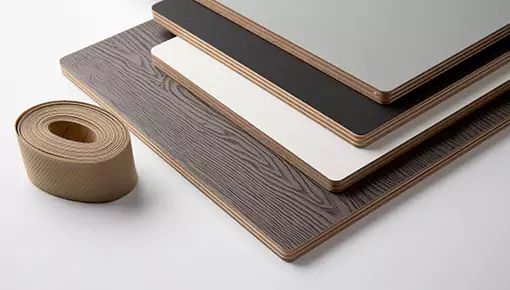
Start with the two surfaces
What are you actually bonding?
The decorative face is only part of the story. Adhesive meets the cut panel edge and the back of the edging. Board porosity, back treatment and edging stiffness all affect the result.
| Edging material | Panel substrate | What to confirm before a trial |
|---|---|---|
| PVC / ABS edging | MDF, particleboard or plywood | Identify the exact edging grade and its back coating or primer. Check adhesive compatibility with that backing, panel-edge quality and material temperature. Recheck the bond when the edging supplier or batch changes. |
| Wood veneer / solid wood edging | MDF, particleboard or plywood | Confirm wood species, moisture condition, thickness and surface preparation. Check that the edging fits the panel edge and receives consistent pressure along the joint. |
| Melamine / HPL edging | MDF, particleboard or plywood | Inspect the bonding face, backing treatment and cleanliness. Check wetting, adhesive coverage and pressure contact. Evaluate the actual backing rather than the decorative face. |
| PP / PMMA edging | Wood-based panels, subject to system compatibility | Obtain the edging supplier’s adhesive and primer requirements. Confirm the exact grade and backing treatment, then test the complete material combination. Do not assume settings used for PVC or ABS will transfer unchanged. |
Selection guide, not a product compatibility guarantee. These are general edge banding material combinations. They do not indicate that Fokis PW700 is approved for every material listed. Confirm the adhesive grade on your actual panel, edging and production equipment, including the intended service conditions.
Choose the adhesive system
EVA, PO or PUR?
These are adhesive chemistries. Pellets, granules and cartridges describe supply forms. Confirm both the chemistry and the feed format your machine can process.
01 / THERMOPLASTIC
EVA
Ethylene-vinyl acetate
Bond formation
Sets as the adhesive cools.
Consider for
Routine interior panel edging where an EVA grade meets the material and end-use requirements.
Plan around
Open time, line speed and heat exposure. Filled and unfilled grades can differ in appearance and yield.
02 / THERMOPLASTIC
PO
Polyolefin
Bond formation
Also sets by cooling.
Consider for
Applications seeking a different balance of processing stability and heat resistance.
Plan around
Grade-specific adhesion and processing conditions. Confirm compatibility before a changeover.
03 / REACTIVE HOT MELT
PUR
Reactive polyurethane
Bond formation
Initial cooling is followed by moisture-driven cross-linking.
Consider for
Demanding heat or moisture exposure, where a validated PUR system is required.
Plan around
PUR-compatible equipment, sealed handling, cure time and an approved cleaning routine.
Troubleshoot the bond
Where does the edge
start to fail?
Use the symptom to choose what to inspect first. Keep an untreated comparison sample and record one adjustment at a time.
Look at both separated surfaces.
Photograph the board and edging back. Record where adhesive remains, whether wood fibres tear, and when the defect appears. A photograph alone cannot establish the cause.
01. Edging peels off soon after pressing
Inspect both sides of the failed joint. Adhesive remaining mainly on the panel or the edging helps identify which interface needs attention. It does not, by itself, prove that the adhesive is unsuitable.
Check first: edging backing and primer compatibility, dust on the panel edge, material temperature, actual adhesive temperature, coverage and pressure contact. Confirm that the edging reaches the pressure zone within the adhesive’s working window.
Record: photos of both separated faces, panel and edging batch, adhesive grade, feed speed and when the lift first appears.
02. Gaps appear at the ends or along part of the edge
Check joint fit and pressure coverage. Local gaps may involve panel-edge geometry, edging tension, uneven adhesive transfer or incomplete pressure contact. Increasing the glue quantity alone may not resolve them.
Check first: panel squareness and edge quality, edging flatness, application coverage and pressure-roller alignment. Look for a repeating pattern at the leading end, trailing end or a specific position on the panel.
Record: gap location, panel dimensions, edging thickness, machine settings and whether the defect repeats on consecutive panels.
03. The glue line is thick, uneven or too visible
Separate appearance from bond performance. A visible line can involve adhesive colour, application quantity, panel-edge quality or joint fit. A thinner line is not automatically a stronger bond.
Check first: adhesive colour against the panel and edging, application uniformity, actual processing temperature and pressure. Check whether a pale line comes from trimming damage or stress whitening rather than exposed adhesive.
Record: close-up photos before and after trimming, application settings and bond-test results. Confirm adequate coverage before reducing the adhesive quantity.
04. Adhesive strings collect on the panel or machine
Check application conditions before changing the grade. Stringing can be influenced by adhesive viscosity, temperature, application quantity and the condition of the application system.
Check first: actual adhesive temperature against the grade’s technical data sheet, roller cleanliness and application settings. Follow the equipment supplier’s adjustment procedure; do not assume that raising the temperature will solve every stringing problem.
Record: where the strings form, whether they appear continuously or after stops, feed speed and the effect of one controlled adjustment at a time.
05. Dark particles or deposits appear in the adhesive
Review heat exposure and contamination. Prolonged hot holding, overheating or contamination can contribute to deposits and inconsistent application. Fresh adhesive added to a dirty system does not remove the underlying problem.
Check first: temperature history, hot-hold duration, standby settings, tank and roller condition, and storage cleanliness. Follow the adhesive and machine suppliers’ cleaning instructions. Do not mix grades or cleaning agents without confirming compatibility.
Record: adhesive batch, time held hot, stop-and-restart history, cleaning method and photos of the deposits.
06. The joint looks sound, then opens after heat or moisture exposure
Evaluate the complete joint under its service conditions. Initial adhesion does not establish long-term durability. Adhesive performance, panel swelling, edging movement and incomplete coverage may all affect the result.
Check first: the actual exposure, failure location and adhesive grade’s documented performance. Where a reactive adhesive is used, confirm its required curing conditions. Do not treat softening point as the finished joint’s maximum service temperature.
Record: conditioning time, temperature, humidity or water exposure, duration, applied load and failure photos. Agree on a test method and acceptance criteria before comparing alternative adhesives.
Explore the Fokis range
Start with PW700. Match it to your process.
For manufacturers assessing EVA hot melt pellets for wood-based edging and profile wrapping. Bring your material samples and operating conditions to the discussion.
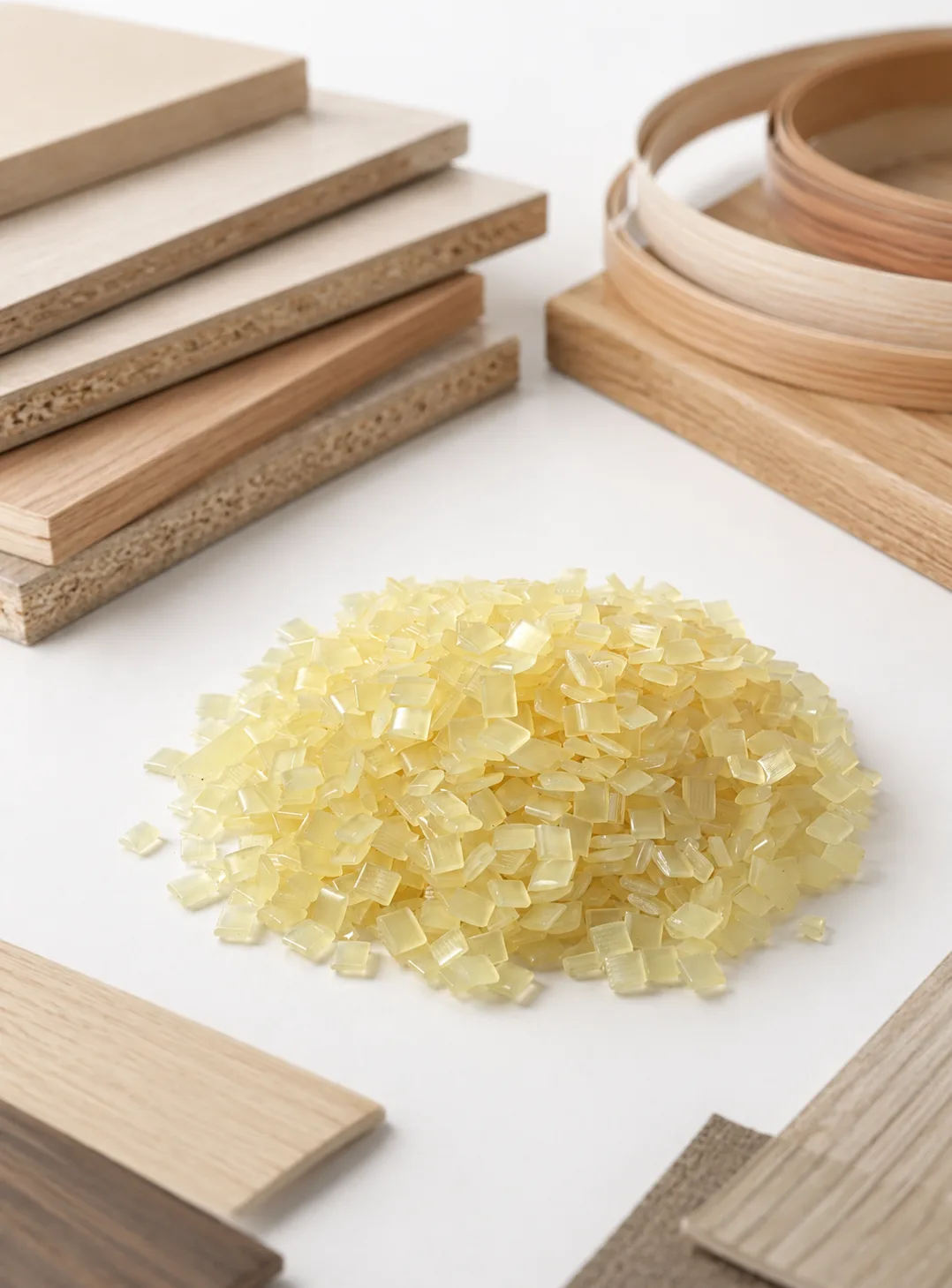
EVA hot melt adhesive pellets
Fokis PW700
For wood-based materials and decorative coverings.
Light yellow
Granule appearance
25 kg / bag
Standard packaging
Suitable for semi-automatic edge banding, manual machinery, and profile wrapping. Supports solid wood profiles, particleboard, MDF, decorative paper, and veneer.
For plastic edging or demanding heat and moisture exposure, share the exact material and performance target so suitability can be assessed through a trial.
Keep the process repeatable
Four production checkpoints.
A good first piece is the starting point. Confirm the same result after changes in materials, line conditions and production stops.
01 / PREPARE
Board and edging
Acclimatise materials. Check moisture, clean square edges and back treatment. Keep adhesive sealed, within its storage limits and traceable by batch.
02 / APPLY
The working window
Verify actual application temperature. Coordinate coverage, feed speed and pressure contact within the grade’s instructions and machine limits.
03 / PAUSE
Stops and changes
Follow standby and cleaning instructions. Avoid unnecessary hot holding. Keep incompatible adhesive or cleaner residues out of the next run.
04 / RELEASE
The finished edge
Inspect after cooling or the specified cure. Check trimming, joint closure and the agreed heat or moisture exposure before approving production.
Application temperature
A processing condition for melting and applying a specific grade.
Softening point
A material property measured by a stated test method.
Bond heat resistance
A result tied to materials, load, exposure time and a test method.
Use extraction and protective equipment specified by the SDS. Isolate equipment for maintenance and follow the machine’s instructions. “Solvent-free” does not mean heated adhesive produces no vapours.
Bring one bond.
Record the conditions.
A useful trial connects the adhesive, the machine and the finished component. Prepare a short brief for Fokis and include samples or photographs when you contact us.
Application support
Edge banding
adhesive questions.
Practical answers for the next material or process decision.
What adhesive should I use for edge banding?
Select an edge banding adhesive by the panel substrate, edging material and backing, machine requirements and finished product’s intended use. EVA, polyolefin (PO) and reactive PUR hot melts are options, but suitability depends on the specific grade.
Confirm the application temperature, viscosity, open time and feed-speed requirements against your equipment. Validate the complete joint under the heat, moisture and loading conditions relevant to the finished furniture.
Can hot melt adhesive bond PVC or ABS edging to MDF?
Yes, a suitable edge banding hot melt can bond compatible PVC or ABS edging to MDF. However, the edging’s back coating or primer is part of the bonding system. The material name alone does not confirm compatibility.
Check the edging supplier’s recommendations and test the actual edging batch, panel edge and adhesive together. For Fokis PW700, request a material trial before treating PVC or ABS compatibility as confirmed.
Are all edge banding glue pellets EVA?
No. “Pellets” and “granules” describe the supply form, not the adhesive chemistry. Check the product’s technical data sheet to identify its polymer system and processing requirements.
Reactive PUR hot melts require moisture-controlled handling and a compatible application system. Do not replace an EVA product with PUR simply because the supply form appears suitable for the machine. Confirm equipment, packaging, cleaning and shutdown requirements first.
What temperature should I use for edge banding hot melt?
Use the application range specified for the exact adhesive grade and follow the machine manufacturer’s instructions. Check the actual adhesive temperature at the application point; the tank display alone may not describe the temperature reaching the joint.
Application temperature, softening point and bond heat resistance are different measurements. A softening-point value does not establish the maximum service temperature of the finished furniture joint.
Is edge banding hot melt adhesive waterproof?
Do not assume that a hot melt adhesive makes an edge-banded panel waterproof. Performance depends on the adhesive grade, substrate, edging, joint coverage and exposure conditions.
Reactive PUR may be considered where higher moisture or heat resistance is required, but the actual grade, cure conditions and finished joint still need validation. For kitchen or bathroom furniture, agree on the exposure, test method and acceptance criteria before selecting the adhesive.
Is a thin hot melt glue line the same as laser edge banding?
No. Conventional hot melt edge banding applies a separate adhesive between the panel edge and the edging. A thin, well-matched glue line can improve appearance, but it does not make the process laser edge banding.
Laser and other compatible activation systems use edging with a suitable functional layer. They require matched edging and equipment. Confirm the production process before comparing adhesives or specifying a “zero-joint” finish.