
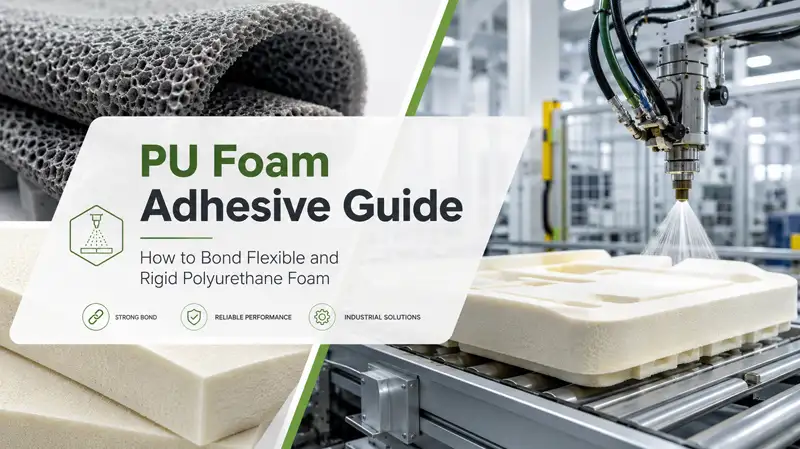
If you work with PU foam in mattresses, sofas, upholstery, automotive interiors, packaging or insulation panels, you may have seen the same problem: the adhesive looks well applied, but the foam still peels, springs open, absorbs too much glue, or becomes too hard after bonding.
In many factories, the first reaction is to spray more adhesive. Sometimes this helps for a short time, but it also raises cost, slows drying and may still leave the real bond line weak. PU foam bonding is not only about adhesive strength. It is about matching the adhesive, the foam structure and the production process.
This guide explains how to choose a PU foam adhesive from a practical production point of view. It covers flexible PU foam, rigid PU foam, common bonding failures, adhesive options and the process details that usually decide whether a trial becomes stable mass production.
Start with the Real Production Problem, Not Only the Foam Name
Two PU foams may both be called sponge, but they can behave very differently on the line. Density, pore size, surface skin, humidity, cutting dust, release agent, spray distance and assembly time can all change the bonding result. Before choosing an adhesive, it is better to define the actual bonding problem clearly.
- Foam type: Is it flexible open-cell foam, memory foam, reticulated foam, molded foam or rigid closed-cell foam?
- Bonding surface: Is it foam-to-foam, foam-to-fabric, foam-to-leather, foam-to-wood, foam-to-plastic, foam-to-metal or foam-to-facing material?
- Production method: Is the factory using manual spray, automatic spray, roller coating, hot-melt dispensing or 1K/2K mixing equipment?
- Main failure: Is the problem high glue consumption, weak peel strength, spring-back, hard bond line, odor, heat failure or slow drying?
- End-use condition: Will the product face body contact, repeated compression, high temperature, humidity, outdoor exposure or automotive interior requirements?
Recommended PU Foam Adhesive by Application
| Application | Common Adhesive Choice | What the Factory Usually Cares About | Practical Selection Notes |
|---|---|---|---|
| Mattress foam bonding | Water-based spray adhesive | Low odor, low VOC, soft touch, stable spray coverage, controlled glue cost | Do not only test initial bonding. Check odor after drying, softness of the bond line and compression recovery after repeated pressing. |
| Sofa and upholstery production | Water-based spray adhesive or solvent-based spray adhesive | Fast positioning, flexible bond, easy operation, low rework rate | For curved foam or wrapped edges, initial tack matters. If parts spring open, adjust adhesive tack, open time and pressing method together. |
| Automotive interior foam | Low-VOC water-based adhesive, PUR hot melt or selected PU adhesive | Odor control, heat resistance, aging performance, consistent process | Automotive use should be tested under heat and aging conditions. A bond that is strong at room temperature may fail in a hot cabin. |
| Foam-to-fabric or foam-to-leather lamination | Water-based spray adhesive or hot-melt adhesive | Soft hand feel, no hard spots, uniform coating, no stain-through | A very strong adhesive is not always the best choice if it makes the laminate stiff or changes the feel of the finished product. |
| Rigid PU insulation board | 1K/2K polyurethane adhesive or compatible structural adhesive | Surface wetting, panel strength, moisture and temperature resistance | Closed-cell foam absorbs little adhesive. Surface wetting and pressure are often more important than applying a thicker layer. |
| Packaging and protective foam | Hot-melt adhesive or economical spray adhesive | Fast assembly, cost control, enough holding strength | Choose based on line speed and cost. Over-specifying the adhesive may add cost without improving the packaging function. |
| Medical, sports and specialty foam products | Specialized water-based adhesive or flexible PU adhesive | Low odor, safety, fatigue resistance, long-term flexibility | Test the finished product, not just a small flat sample. Repeated deformation can expose failures that do not appear in a simple peel test. |
Flexible PU Foam vs. Rigid PU Foam: Why They Need Different Adhesive Logic
Flexible and rigid PU foam do not fail in the same way. Flexible foam often creates problems because it absorbs adhesive and moves during use. Rigid foam often creates problems because the surface does not absorb enough adhesive and needs better wetting.
| Foam Type | Typical Structure | Common Bonding Issue | Adhesive Requirement |
|---|---|---|---|
| Flexible PU foam | Mostly open-cell, soft and compressible | Adhesive sinks into the pores, causing high consumption and a starved bond line. | Controlled spray amount, suitable viscosity, good initial tack and a flexible cured film. |
| Memory foam | Open-cell viscoelastic foam with slow recovery | Bonding can affect softness and comfort. Odor is also very noticeable in bedding. | Low-odor adhesive with a soft bond line and good compatibility. |
| Reticulated foam | Very open skeletal structure with high air and water permeability | Extreme porosity makes over-penetration easy. | High-solid adhesive, fine spray control and careful trial coating weight. |
| Rigid PU foam | Mostly closed-cell and dimensionally stable | Poor wetting or surface contamination leads to weak adhesion. | Strong wetting ability, pressure during assembly and good environmental durability. |
| Molded PU foam parts | Formed in a mold; density and surface skin vary | Curved surfaces, release agent or uneven surfaces reduce bonding reliability. | Surface cleaning or treatment, compatible adhesive and enough fixture time. |
Understanding PU Foam Types from a Bonding Viewpoint
Flexible PU Foam
Flexible polyurethane foam, often called sponge foam, is widely used because it is soft, light, breathable and easy to cut or shape. In bonding, its biggest advantage and biggest problem come from the same place: the open-cell structure. It gives the foam comfort and rebound, but it can also pull adhesive away from the surface.
| Foam Type | Where It Is Used | Bonding Experience |
|---|---|---|
| Conventional foam | Sofas, chair cushions, packaging inserts, cleaning sponges, shoe lining | Usually easy to bond, but low-density foam can absorb adhesive quickly. Good spray control is important for cost. |
| High-resilience foam | Premium sofas, office chairs, automotive seating, mattress support layers | The adhesive must follow repeated compression and rebound. A brittle film may crack over time. |
| Memory foam | Mattresses, pillows, medical cushions and ergonomic products | Low odor and soft hand feel are critical. A hard bond line can reduce comfort and create customer complaints. |
| Reticulated foam | Filters, acoustic products, outdoor furniture and ventilation components | Because the structure is very open, a normal wet spray may penetrate too deeply. Trial runs should focus on coating weight and spray pattern. |
Rigid PU Foam
Rigid polyurethane foam is different. It is mainly valued for insulation, low weight, dimensional stability and structural support. Because many rigid foams are closed-cell, the adhesive often stays on the surface. That sounds easier, but it means the bond depends heavily on surface wetting, pressure and cleanliness.
| Rigid Foam Form | Where It Is Used | Bonding Experience |
|---|---|---|
| Insulation board | Walls, roofs, cold storage panels and pipe insulation | Check both the foam and the facing layer. Foil, kraft paper and coated surfaces may require different adhesive behavior. |
| Spray foam | Building gaps, attics, refrigerated trucks and irregular cavities | The foam may bond while expanding, but substrate cleanliness and moisture conditions still influence adhesion. |
| Molded parts | Appliance parts, automotive components, decorative parts and wood imitation | Release agent on the surface is a common hidden reason for poor bonding. Cleaning or treatment may be needed. |
| Structural foam | Buoyancy products, model cores and lightweight structural parts | Load, temperature and moisture exposure should decide whether a PU adhesive or stronger structural adhesive is needed. |
Technical Reasons Why PU Foam Is Difficult to Bond
Adhesive Over-Absorption in Open-Cell Foam
In flexible foam, the adhesive can be pulled into the cell structure by capillary action. Operators may see the surface become dry very quickly and assume the adhesive has set. In reality, there may not be enough adhesive left at the interface to form a continuous bond line. This is why spraying more adhesive is not always the right solution. The better solution is usually proper viscosity, solids content, spray pattern, coating weight and assembly timing.
Poor Wetting on Closed-Cell or Coated Surfaces
Rigid PU foam and coated foam surfaces absorb little adhesive. If the adhesive does not wet the surface well, it may sit in small beads or uneven islands instead of forming full contact. This reduces peel strength and makes edge lifting more likely. Surface dust, release agent and oil can make the problem worse.
Flexibility Mismatch
For soft foam products, the bond line must move with the foam. A hard adhesive may give a high initial strength number on a small sample, but it can crack or peel when the foam is bent, pressed or rolled. For mattresses, sofas and seat cushions, softness and fatigue resistance often matter more than maximum hardness.
Solvent Sensitivity
Solvent-based adhesives can provide fast tack, but they must be tested carefully. Some solvents may shrink, harden or deform sensitive foam. This risk is higher with thin foam, memory foam or foam parts where appearance and softness are important. A short compatibility test before mass production can prevent a costly batch problem.
Heat, Humidity and Aging
A bond that passes a same-day peel test may still fail after heat, humidity or repeated compression. Automotive interiors, mattresses, outdoor furniture and insulation panels all need different aging tests. The adhesive should be selected based on the real use environment, not only the first bonding result.
Comparison of Mainstream Adhesive Solutions for PU Foam
| Adhesive Type | Main Advantages | Limitations to Check | Typical Applications |
|---|---|---|---|
| Water-based spray adhesive | Low odor, low VOC, soft bond line, safer operation, suitable for many foam products | Drying speed depends on ventilation, temperature and humidity. Spray process must be controlled. | Mattresses, sofas, upholstery, baby products, soft foam lamination and many furniture applications. |
| Solvent-based spray adhesive | Fast drying, strong initial tack, useful for quick positioning | Odor, VOC, flammability and possible solvent attack on foam. Workplace safety is important. | Traditional upholstery, fast manual assembly and applications where rapid tack is the main priority. |
| Hot-melt adhesive | Very fast setting, clean process, good for automated production | Needs heating equipment. Some grades may create a harder bond line. | Packaging, automated assembly and selected foam lamination processes. |
| PUR hot-melt adhesive | Fast handling plus moisture-curing durability, stronger heat and aging resistance than many standard hot melts | Requires proper equipment, moisture control and nozzle maintenance. | Automotive headliners, technical laminates and higher-performance automated bonding. |
| 1K/2K polyurethane adhesive | High strength, adjustable flexibility or rigidity, strong durability | Process is more complex. Pot life, mixing ratio, pressure and cure time must be managed. | Rigid PU foam panels, structural bonding, molded parts and demanding foam-to-substrate applications. |
Common PU Foam Bonding Problems and Practical Solutions
| Problem on the Line | What Usually Causes It | What to Try First |
|---|---|---|
| High adhesive consumption but weak bonding | Open-cell foam absorbs the adhesive too deeply. | Reduce over-wet application, adjust spray pattern, test higher-solids adhesive and check whether single-sided or double-sided spraying works better. |
| Foam parts spring open after assembly | Foam rebound force is stronger than the adhesive initial tack. | Use stronger initial tack or green strength, adjust open time, add temporary pressure or improve the fixture method. |
| Bond line becomes hard | Adhesive film is too rigid or too much adhesive was applied. | Use a flexible adhesive grade and control coating weight. Test the final hand feel, not only peel strength. |
| Edges peel after bending or compression | Flexibility mismatch or incomplete contact during pressing. | Choose a softer adhesive film, increase pressure uniformity and test compression fatigue. |
| Strong odor in finished product | Solvent or residual formulation odor remains in the foam. | Use low-odor water-based adhesive, improve drying conditions and test odor after the product is packed. |
| Poor bonding on rigid PU foam | Low surface energy, dust, release agent or poor wetting. | Clean or treat the surface, confirm wetting and select a PU or structural adhesive that matches the facing material. |
| Failure after heat or humidity exposure | Adhesive durability is not enough or cure is incomplete. | Run heat aging and humidity aging tests. Confirm drying, curing and pressure conditions before production. |
Process Control Points That Matter in Real Foam Bonding
Control Coating Weight
More adhesive does not automatically mean a stronger bond. On open-cell foam, excessive wet adhesive may simply disappear into the foam. On soft products, too much adhesive can also create hard spots and slow drying. A stable coating weight is one of the easiest ways to reduce cost and improve consistency.
Keep a Stable Spray Pattern
Spray distance, air pressure, nozzle condition and operator habit can change the bond result. In manual production, two workers using the same adhesive may get different results. For high-volume foam bonding, it is useful to define a standard spray pattern and train operators with sample panels.
Respect the Tack Window
Every adhesive has a suitable open time. If parts are joined too early, water or solvent may still be trapped. If parts are joined too late, the adhesive may lose tack. The right timing should be tested under the actual factory temperature, humidity and line speed.
Apply Pressure Where the Bond Is Needed
Light hand pressing may not be enough for curved foam, wrapped edges or large bonding areas. Pressure helps the adhesive make close contact with both surfaces. For parts that spring back, temporary fixtures can make a large difference during early bonding.
Test the Finished Product, Not Only a Small Flat Sample
Flat sample tests are useful, but they do not always show the real production risk. A mattress, sofa cushion, automotive part or insulation panel may face bending, compression, packing pressure, heat or humidity. The final test should be close to the real application.
Fokis support
Frequently asked questions
What is the best adhesive for flexible PU foam?
For most sofa, mattress and upholstery foam bonding, a water-based spray adhesive is often the first option to test. It gives a soft bond line, low odor and low VOC performance. If the line needs very fast positioning or the foam has strong spring-back, initial tack and drying speed should be checked carefully before mass production.
Why does PU foam absorb so much adhesive?
Flexible PU foam is usually open-cell. When adhesive is sprayed too wet or too heavily, part of it moves into the pores instead of staying on the bonding surface. In the workshop, this often looks like a glue-strength problem, but the real issue is an insufficient bond line on the surface. A better spray pattern, suitable viscosity and controlled coating weight can reduce waste and improve bonding.
Why does bonded foam sometimes peel after bending or compression?
This usually happens when the cured adhesive film is too hard for the foam. Soft foam keeps moving during compression, folding and packing. If the adhesive cannot move with it, stress builds up at the interface and peeling may appear. For flexible PU foam, the bond line should remain flexible after drying or curing.
Why do curved foam parts spring open after bonding?
Curved foam, wrapped edges and thick cushions all create rebound force. If the adhesive does not have enough initial tack, the parts may shift before the bond develops. In production, this can often be improved by adjusting drying time, spray amount, pressure, fixture support or selecting an adhesive with stronger early holding power.
Can water-based adhesive bond PU foam effectively?
Yes, provided the process is matched to the adhesive. Water-based spray adhesives need the right drying time, spray amount and assembly window. Joining parts while the coating is still too wet, or after the tack window has passed, can both lead to weak bonding.
Is solvent-based adhesive safe for PU foam?
Solvent-based adhesives can still be used in some foam applications, especially where very fast tack is required. However, compatibility testing is important. Certain solvents may affect foam shape, softness or surface quality. Odor, VOC emission and flammability also need to be controlled in the factory.
What adhesive is commonly used for mattress foam bonding?
Mattress foam bonding commonly uses spray adhesive. For modern mattress production, many factories prefer low-odor water-based spray adhesive because the finished product is used close to the body and odor complaints can directly affect customer acceptance.
How do you bond PU foam without making it feel hard?
Use an adhesive that forms a soft, flexible film and avoid over-application. A very strong but rigid adhesive may create a hard line, reduce comfort or cause edge cracking in soft foam products.
What adhesive is suitable for rigid PU foam?
Rigid PU foam usually needs good surface wetting and durability rather than high penetration. Compatible polyurethane adhesives, structural adhesives or hot-melt systems may be used depending on the facing material, required strength and service environment. Surface dust, release agent and moisture should be checked before bonding.
Glossary of Useful Bonding Terms
| Term | Plain Explanation |
|---|---|
| Initial tack | The immediate grip of the adhesive before it is fully dry or cured. |
| Green strength | The early strength that helps parts stay in position before final cure. |
| Bond line | The adhesive layer between the two materials being bonded. |
| Starved bond line | A weak bond caused when too little adhesive remains at the interface. |
| Wetting | How well the adhesive spreads on and contacts the surface. |
| Open-cell foam | Foam with connected pores that can absorb air, moisture and liquid adhesive. |
| Closed-cell foam | Foam with sealed cells that absorbs little liquid and is often used for insulation. |
| VOC | Volatile organic compounds that may evaporate from some adhesives and affect odor, safety and compliance. |
Bond line: The adhesive layer that remains between two bonded surfaces.
Initial tack: The early holding power that keeps parts in position before full drying or curing.
Open time: The period after application during which the adhesive can still form a good bond.
VOC: Volatile organic compounds released by some adhesive systems, especially solvent-based products.
Open-cell foam: Foam with connected pores that can absorb air, liquid and adhesive easily.
Closed-cell foam: Foam with mostly sealed cells, usually requiring stronger surface wetting rather than penetration.
FOKIS ADHESIVE: Adhesive Selection + Process Support
FOKIS ADHESIVE works with industrial customers on adhesive selection, sample testing and process adjustment. For PU foam bonding, we do not treat the adhesive as a stand-alone product. The final result depends on the adhesive formula, spray method, coating weight, drying or curing condition, pressure and the customer's production speed.
Most foam bonding problems can be improved when the adhesive and process are tested together. This is why we usually ask for the foam type, substrate, application method and failure description before recommending a product.