
Adhesives for footwear production
Footwear Adhesive Solutions for Global Shoe Manufacturing
For shoe manufacturing
and sole assembly.
Find a footwear adhesive for your materials and production line. Compare industrial shoe glue options, investigate sole-bond problems and plan a trial with Fokis.
Written by Fokis Editorial Team
Last updated: October 30, 2026
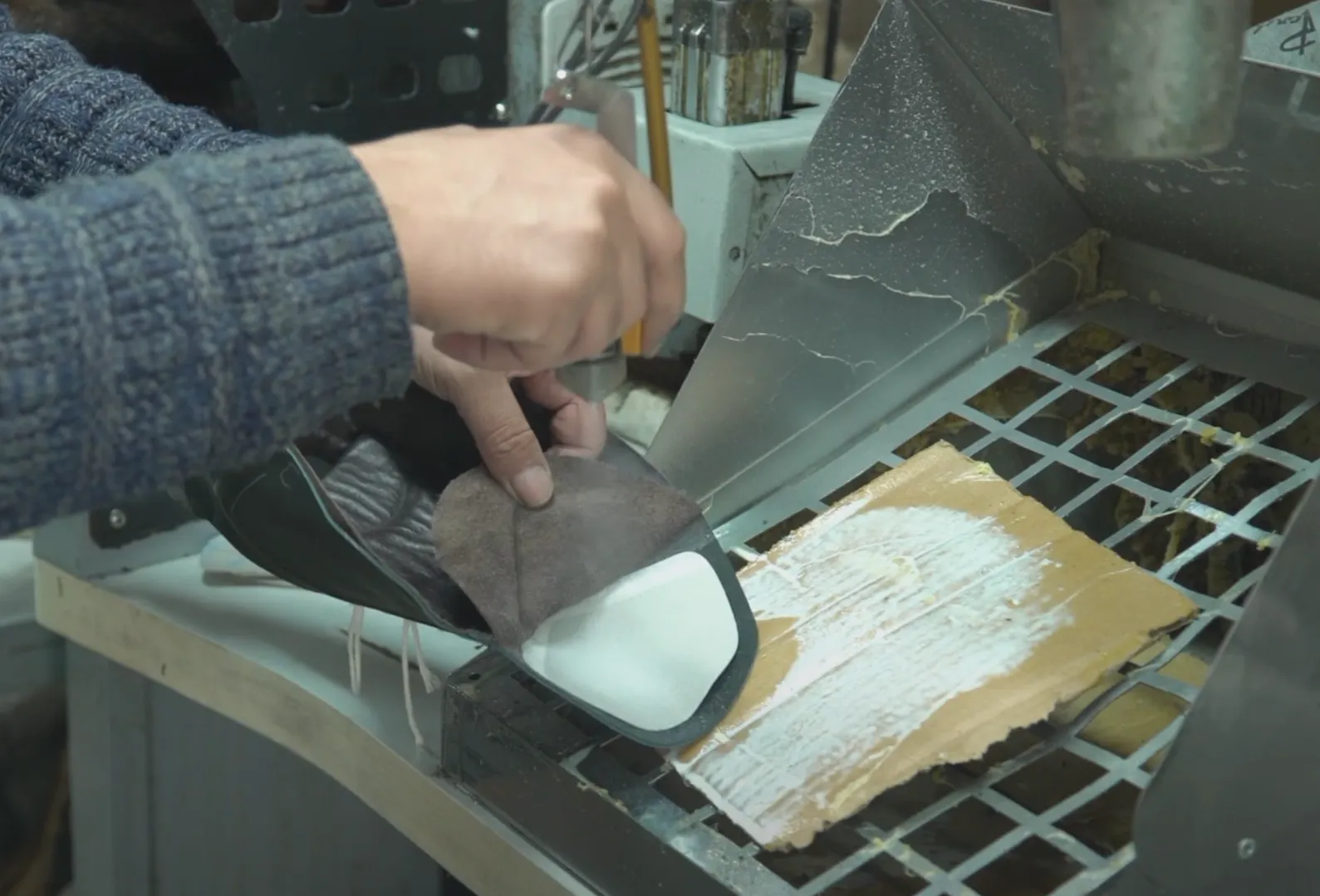
At Fokis, you can find adhesives suitable for your shoe production.
From the shoe to the bond
Built around what you are bonding.
A shoe contains several different bonds. Identify the assembly first, then confirm the exact material grade, surface finish and preparation needed for that interface.
Upper-to-sole assembly
Leather, synthetic or textile uppers joined to sole components. Focus on the prepared upper margin and the matching sole surface.
Midsole-to-outsole bonding
EVA or other foam midsoles joined to rubber or other outsole compounds. Mold skin and release residues deserve particular attention.
Upper & lining lamination
Textiles, synthetic leather, foam and lining layers. Check strike-through, softness, appearance and flexibility as well as adhesion.
“Rubber”, “PU” and “synthetic leather” are starting descriptions. Send the supplier, grade and surface finish when available. A different compound, coating or release agent can change the bonding result.
What are you bonding?
Use this material map to prepare a discussion. Product suitability must be confirmed on your actual components.
| Material pair | Clarify before choosing | What the trial should reveal |
|---|---|---|
|
Leather / synthetic upper ↔ rubber, TPR or PU sole |
Upper coating and backing; exact sole compound; roughing and primer requirements. | Whether the prepared upper and sole both retain adhesion, including around toe and heel curves. |
|
EVA / Phylon midsole ↔ rubber outsole |
Foam grade and density; mold skin; release residue; compatible treatment system. | Whether failure occurs at the interface or inside the foam, and whether heating distorts the component. |
|
PU / TPU components ↔ upper or midsole |
Solid or foamed construction; surface finish; primer compatibility and preparation sequence. | Adhesion after conditioning, flexing and the agreed aging exposure; any coating separation. |
|
Textile / synthetic leather ↔ foam or lining |
Fabric finish and backing; porosity; coating method and adhesive add-on. | Strike-through, staining, stiffness and hand feel alongside bond strength and flex performance. |
These are application categories, not a verified compatibility list for a specific Fokis adhesive. Please consult Fokis to confirm suitability for your material pair. Primer selection and any chemical treatment require the relevant supplier’s instructions.
Troubleshoot the bond
Read the failure before changing the glue
A loose sole is a symptom. Keep both separated surfaces and identify the failure location before changing the adhesive or adding another coat.
01. Adhesive stays mainly on one side
Investigate the exposed interface. Surface contamination, unsuitable treatment, poor wetting or a weak surface coating may be involved.
Compare both sides, confirm the actual material grade and review preparation, primer and the time between treatment and bonding.
Bring to the discussion: photos of both faces, an unbonded sample and the full preparation sequence.
02. Toe or heel lifts after pressing
Investigate contact and early handling. Local gaps, component rebound, uneven pressure or a missed activation/assembly window can produce edge lift.
Check the fit, adhesive-film temperature where activation is required, time to assembly and pressure coverage at curved areas. A press setting alone does not prove full contact.
Record when the lift appears: at release, after de-lasting, during finishing or after storage.
03. Passes today, separates after aging
Investigate durability across the whole joint. Cure, residual carrier, crosslinking where specified, material degradation or coating failure may affect the aged bond.
Compare initial and aged specimens under the same method. Record whether the failure location changes; the weak link may be the substrate or its finish.
Agree before comparing results: exposure, conditioning, test method and acceptance criteria.
04. Foam or the surface coating tears first
Separate material failure from adhesive failure. A cohesive tear in foam and delamination of a coating describe different weak layers.
Retain the fracture surfaces and check the material specification. Substrate tear alone is not a complete pass: load, consistency and aged performance still need to meet the agreed criteria.
Keep the sample batch ID and report the measured result together with the failure mode.
Options to evaluate
Water-based & solvent-based
footwear adhesives.
Changing the carrier changes the process to validate. Compare the complete adhesive system—surface treatment, primer, adhesive and any specified hardener—on your production line.
| Production check | Water-based route | Solvent-based route |
|---|---|---|
| Surface preparation | Confirm wetting and the specified primer on the actual surface. A water-based main adhesive may still be part of a system with solvent-containing treatments. | Confirm preparation and primer compatibility. Solvent content does not remove the need to control mold-release residue, dust or weak coatings. |
| Coating & add-on | Validate coating uniformity and dry adhesive add-on. Changing solids content or application equipment can change the required wet coating weight. | Control coating thickness, coverage and material absorption. Additional coats or dilution should follow the approved product process. |
| Drying on the line | Water removal depends on airflow, temperature, humidity, film thickness and substrate. Challenge the process under humid production conditions. | Provide controlled solvent evaporation and suitable extraction. Thick films and insufficient drying can retain solvent and weaken the joint. |
| Activation & assembly | If heat activation is specified, establish the required adhesive-film temperature and assembly window after adequate drying. | Some footwear grades require heat activation; others use different contact-bonding procedures. Follow the selected grade’s instructions. |
| Mixing & working time | Confirm whether the grade is 1K or 2K. For 2K systems, follow the specified hardener, mix ratio and usable pot life. | Confirm whether a hardener is required and how mixing affects use time. Do not transfer another product’s ratio or pot life. |
| Handling & changeover | Check adhesive, primer and hardener SDS requirements. Confirm storage limits, cleaning procedure and compatibility with existing equipment. | Control flammable vapor and occupational exposure according to the SDS and site requirements. Include extraction, storage and cleaning in the evaluation. |
Fokis PU Adhesives for Footwear
For shoe sole bonding, compare Fokis 8805 for a water-based PU route and Fokis PU 444 for a solvent-based PU route. Confirm suitability on your actual materials and production line before selecting a system.
Solvent-based series
Solvent-based
Fokis PU 444
A solvent-based polyurethane adhesive positioned for shoe bonding, sole attachment and upper-to-sole assembly.
Why discuss this product
Your footwear line uses a solvent-based PU route, including applications involving leather or synthetic leather.
What the trial must confirm
The exact sole compound, surface treatment, application procedure and initial / aged bond performance.
Bring to your enquiry
Both materials, your current adhesive system, line conditions and the required end-use tests.
Water-based series
Water-based
Fokis 8805
A water-based PU adhesive for footwear bonding. Evaluate Fokis 8805 on your actual sole and upper materials before introducing a water-based process.
Why include it in the discussion?
Your footwear line is evaluating a water-based PU route.
Review the material pair, surface preparation and drying capability before planning a trial.
What should the trial confirm?
Wetting, drying under workshop conditions, any specified activation and pressing steps, and initial and aged bond performance.
Bring to the enquiry
Both materials, your current adhesive and primer system, drying equipment, line speed and required tests.
Make the trial useful
Application testing
& sample evaluation.
Use your actual materials and a recorded process. A useful result shows the strength, the failure location and the conditions that produced it.
01
Define the pair and the target.
Identify both material grades, coatings, the bonded area, the end-use conditions and the customer’s required tests.
02
Establish a recorded baseline.
Keep your current adhesive system as the reference. Record preparation, coating, drying, activation where required, assembly and pressing.
03
Check the joint after conditioning.
Evaluate the initial bond and agreed aged / flexed specimens. Report the result and failure mode together; retain samples and batch IDs.
04
Confirm on the real shoe and line.
Check curved areas, line stops and early handling. Recheck when the material grade, treatment system or process changes.
Confirm sample quantities and receiving arrangements before shipping.
A useful trial record includes
Material & batch IDs
Preparation / primer
Adhesive & hardener
Dry add-on
Temperature / humidity
Drying / activation
Document what was tested and what still needs confirmation before production.
Before your first trial
Footwear adhesive
questions.
Practical starting points for production, technical and sourcing teams.
Which adhesive should I use for EVA-to-rubber bonding?
Confirm the EVA grade, rubber compound and surface condition first. The required treatment or primer depends on the materials and adhesive system. Ask for a matched process and compare prepared samples; “EVA” and “rubber” alone do not establish compatibility.
Does every footwear adhesive need a hardener?
No. Both the requirement and the compatible hardener depend on the product. Confirm whether the selected grade is a one-component or two-component system, then follow its technical instructions for mixing and use time.
Why does a dry-looking film still give a weak sole bond?
Surface appearance does not confirm adequate carrier removal, activation or contact. Review the whole sequence: preparation, film thickness, drying, any specified heat activation, time to assembly and pressure distribution. Retain the failed joint to identify the weak interface.
How should we compare Fokis 8805 with Fokis PU 444?
Fokis 8805 is a water-based PU adhesive, while Fokis PU 444 is a solvent-based PU adhesive. Start with the same material pair and agreed acceptance criteria, then follow the application procedure specified for each product.
Compare preparation, drying, any required activation, assembly timing, pressing and initial and aged bond performance. Record process changes, drying energy, rework and rejects alongside adhesive consumption. Do not assume a direct replacement without a line trial.
Can Fokis 8805 or PU 444 bond every footwear material?
Suitability must be confirmed for the actual material pair. Rubber, EVA, PU, TPU, leather and synthetic uppers can differ in composition, surface finish and preparation requirements. A material name alone does not establish compatibility.
Review Fokis 8805 water-based PU adhesive or Fokis PU 444 solvent-based shoe adhesive, then send representative samples and process details to discuss an appropriate trial.
What should we send for an adhesive evaluation?
Send both unbonded materials, their identification and surface-treatment details. If investigating a defect, include an intact bonded sample, both failed surfaces and photos showing the location on the shoe. Add the line conditions, current adhesive system and required tests; agree sample quantities and shipping instructions with Fokis first.
Tell us what needs to hold.
Share your material pair and one production challenge. Start a discussion about a suitable product trial.